
How to Keep Wix CMS in Sync with an External API
7 October 2026 · 3 min read
Connect an external API to Wix CMS without duplicate records or accidental removals. A practical guide to mapping, schedules and reliable updates.


You update a record in your business software, then update it again on your website. That is a good sign the two systems should be talking.
Wix can display information from an external API, but fetching data is only the first step. A dependable integration also needs to recognise existing records, decide which fields it owns and cope with an interrupted update. Here is how we would plan that work before writing the connection.
Decide whether you need a live request or a CMS copy
A live request retrieves information when it is needed. It can suit a small lookup where freshness matters and the external service responds reliably. The visitor experience then depends partly on that service being available.
A synchronised CMS copy keeps the website's usable content in Wix. That can suit catalogues, directories and listing pages, particularly when editors need Wix layouts around the imported information. The trade-off is freshness: the website reflects the last successful update, not necessarily the source's current state.
Write down an acceptable delay. “Automatic” could mean every few minutes, hourly or overnight. That business requirement helps determine whether a schedule is sufficient or whether supported source webhooks are worth investigating.
Map records before mapping fields
Start with an unchanging external record ID. A title, email address or product name can change; it should not be the only way to recognise an existing item. Keep a mapping between the external ID and the Wix record so subsequent runs update the right item.
Then agree which system owns each field. The source might own price and availability while a Wix editor owns a marketing introduction. Updating the entire CMS record indiscriminately could erase the editor's work. These are design recommendations, not requirements imposed by every API.
For each incoming field, specify its expected type, whether it is optional and what happens if it is missing. A missing price should not quietly become zero. An absent image might use a deliberate placeholder rather than a broken gallery.
Put credentials and validation behind the scenes
Wix's Fetch API supports external requests. Calls requiring private credentials belong in backend logic, with secrets kept in appropriate secret storage. Return only the fields the page needs, rather than exposing the external service's full response.
Validate the response before saving. Check that it represents the expected dataset and handle pagination explicitly. A response containing the first hundred records does not establish that the remaining records have disappeared.
Treat removals differently from updates
An explicit withdrawn status is useful evidence. A missing record in a failed or partial request is not. If removal relies on comparing two complete datasets, complete and validate the full source retrieval before applying that comparison.
We also recommend keeping a last-successful-sync timestamp, a failed-run log and a way to retry safely. Reprocessing the same source record should not create another website item. That repeat-safe behaviour is often called idempotency.
A project example: property listings
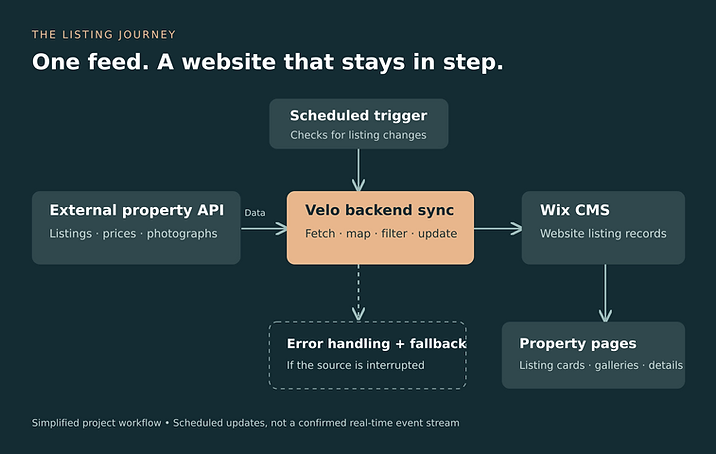
For Mitchell Torre, we connected an external property feed to Wix CMS and dynamic pages using scheduled backend updates. The project illustrates why listings, images and status changes belong in one integration. The workflow below shows that project context; the broader safeguards above are recommendations for planning a similar sync.
Read the Mitchell Torre case study.

What to include in your integration brief
Bring the API documentation, a sample response, approximate record count, required update delay and rules for withdrawn items. Also identify any website fields staff must continue editing themselves. Those details reveal more about the work than “connect this API” alone.
If your team is maintaining the same content twice, Wix Rocket can help map the source, website and update rules before choosing the integration approach.